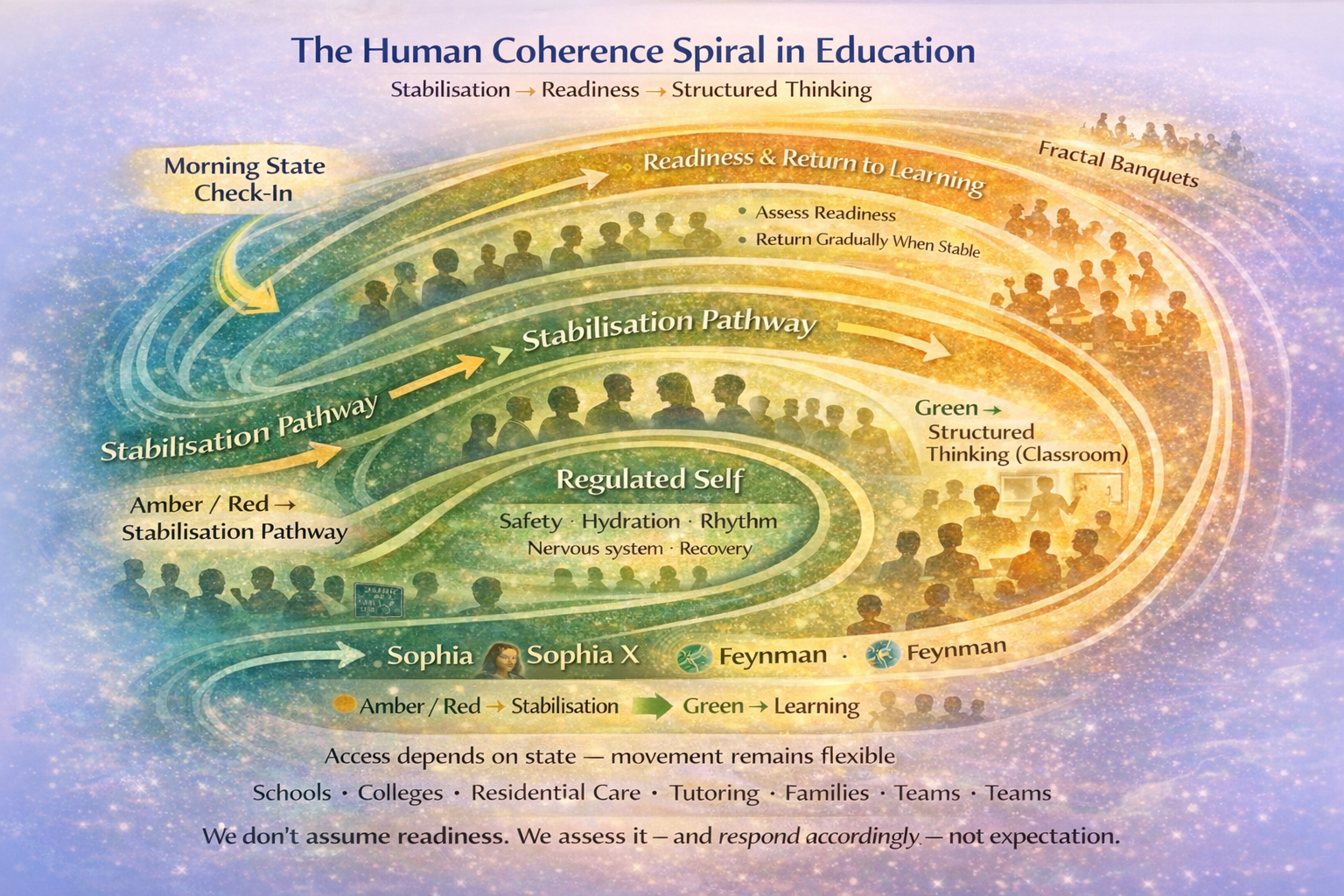
Whole-Educational Rollout Plan (6–12 Weeks)
The Unified School/College Model
Step 1 — Morning Check-In (Schools can implement this most consistently due to full-day structure)
Because they have a full day structure.
Daily AM:
- quick state read
- Green / Amber / Red
Then:
Green → class
Amber/Red → Stabilisation Pathway
Step 2 — Stabilisation Pathway
In schools this can be:
- pastoral room
- nurture space
- SEND base
- inclusion room
clear purpose: state stabilisation
This is not:
- isolation
- behaviour management
- holding space
This is:
supporting the learner into a state where learning becomes possible.
Step 3 — Return to Learning
- same day where possible
- or gradual
- based on state, not time
Phase 1 — Orientation (Weeks 1–2)
Introduce:
- state vs behaviour
- Red / Amber / Green
- simple response shifts
state-based routing concept
Outcome:
- shared language begins
- staff curiosity replaces resistance
Phase 2 — Live Application (Weeks 3–6)
- trial morning check-in (small group first)
- trial stabilisation pathway
- staff begin using response shifts
- optional Sophia-supported reflection
Outcome:
- staff begin to pause before reacting
- early reduction in escalation
- language begins to shift
Phase 3 — Guided Stabilisation (Weeks 7–10)
Expand and refine:
- identify:
- which learners require routing
- when
- how often
- refine:
- stabilisation environment
- staff deployment
Outcome:
- reduced variation between staff
- more predictable learner experience
Phase 4 — Reflection & Embed (Weeks 10–12)
Define:
- routing criteria
- re-entry approach
- shared staff response principles
Outcome:
- system clarity
- consistent application
- sustainable model
Key Difference: School vs College Delivery
Schools
- daily AM check-in possible
- easier pattern tracking
- earlier intervention
Colleges
- cohort-based intake grouping
- flexible routing
- less frequent formal check-ins
Same Core System
- state-first approach
- shared staff response model
- Sophia-supported reflection
- stabilisation pathway
DIFFERENT DELIVERY:
| Schools | Colleges |
|---|---|
| Daily check-in | Intake grouping |
| Fixed timetable | Fluid timetable |
| Class-based routing | Cohort-based routing |
CONSIDER THIS:
“ASD & ADHD does not determine state”
We move from:
Diagnosis → placement
To:
State → placement → transition
Our system replaces:
Diagnosis → placement
With:
State → placement → transition
Final reflection
This represents a:
- ✔ staff training model
- ✔ system routing model
- ✔ intake model (college)
- ✔ daily model (schools)
This is no longer:
“a better behaviour approach”
This is:
a full education system redesign based on state
“We don’t assume readiness.
We assess it — and respond accordingly.”